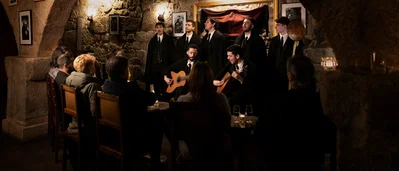


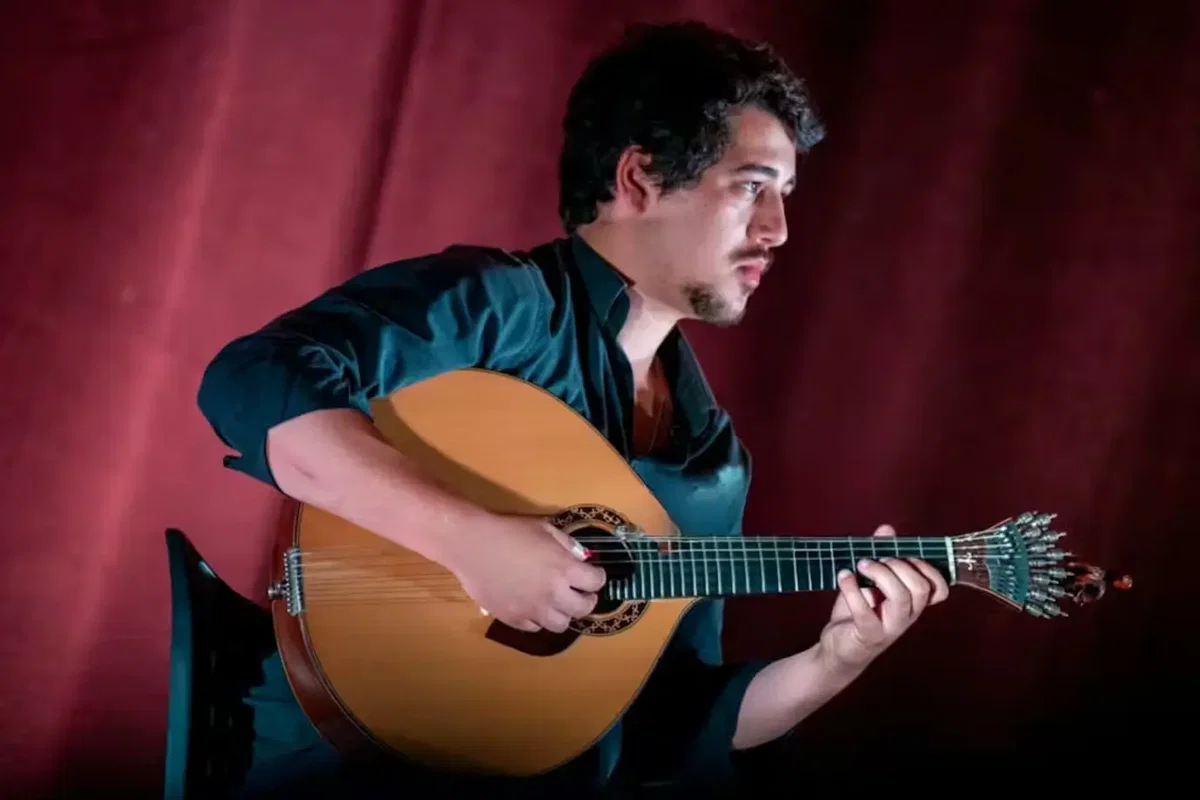
The Portuguese guitar descends from the Renaissance cittern, an instrument most of Europe gave up while Lisbon and Porto kept building it. A guitar made in Lisbon in 1764 already has today’s shape. Only the Portuguese guitar can play the Fado Lopes, a solo attributed to a guitarist who drove a coach at the Royal Palace. And the first faithful recordings of the modern Lisbon guitar were made in 1928 on the stage of a Lisbon theatre, because Portugal had no recording studios yet.
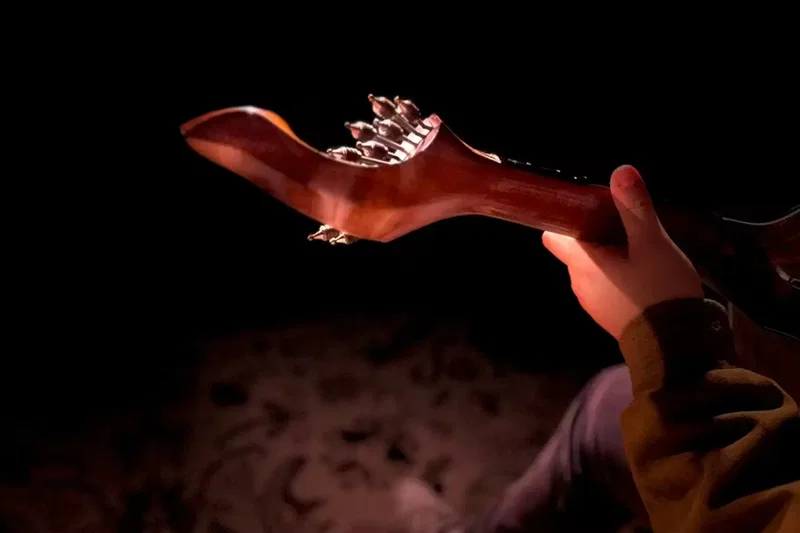
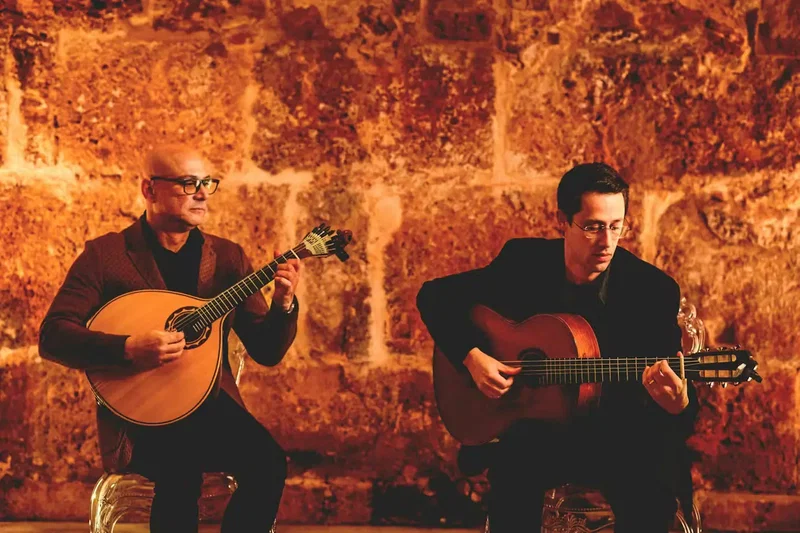
In a Fado house it is the round, pear-shaped instrument with twelve steel strings that you hear ringing beside the voice. At first sight it could pass for an oversized mandolin, until you notice the fan of metal tuning screws on its head. It is the singer’s partner: it plays the opening bars, answers each sung line, and has a handful of pieces that belong to it alone.
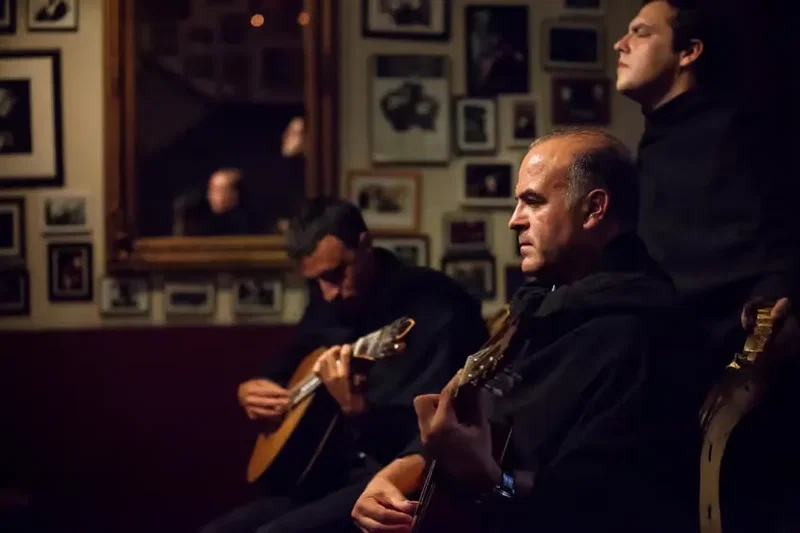
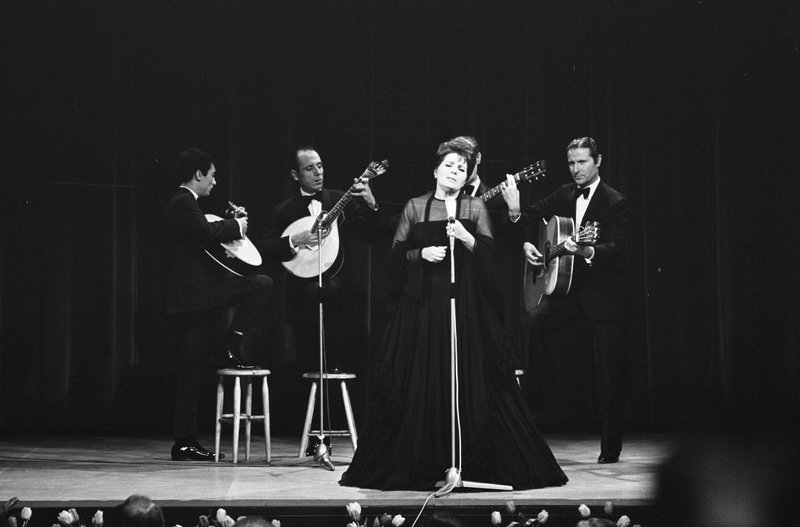
The full line-up behind the singer has three instruments. The Portuguese guitar carries the melody around the voice, a six-string classical guitar keeps the chords and the pulse, and an acoustic bass guitar, the viola baixo, adds the low notes. The bass is the newest of the three, brought into Fado by studio recording in the 20th century, and plenty of houses still play with the two guitars alone.
What the Guitar Does While the Fadista Sings
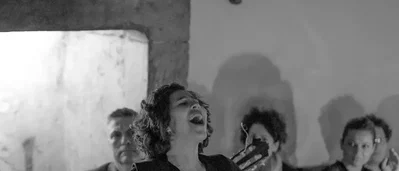
The guitarist opens the Fado with a short introduction and from then on works in the gaps. Each time the singer, the fadista, finishes a line, the Portuguese guitar answers with a phrase of its own. Sometimes it follows the melody, sometimes it pulls against it. None of this is written down: the answers are made up on the night.
In the slower Fados the singer leaves a pause at the end of a line for the guitars to move into. Musicians call it the compasso de espera, the bar of waiting, and you can hear it clearly in the Fado Menor; in the faster Fado Corrido the replies come quicker and shorter. The melody of a traditional Fado is fixed, so what changes from one night to the next is the singer’s phrasing and the guitarist’s replies. Not every song of the evening works this way: our guide to the styles of a Lisbon Fado evening separates the traditional Fados from the songs composed for a single poem.

Twelve Strings in Six Pairs
The twelve strings are steel and run in six courses: pairs set close together and played as one. Steel and the doubled strings give the guitar its bright, metallic ring next to the softer nylon of the classical guitar. At the top of the neck the strings wind onto the fan of tuning screws. The guitar is plucked, never strummed, with two fingers of the right hand, the thumb and the index, and always with the nails: some players use their own, others wear plastic ones over the fingertips.
The tuning decides what the instrument can play. The Lisbon tuning makes use of open strings in E, and in the Fado Lopes, a piece for the guitar alone, those open strings let it play the tune and its own accompaniment at the same time. A classical guitar can’t reproduce it, and neither can a piano.
How It Differs from a Spanish Guitar
The other instrument on stage is the classical guitar, which many English speakers call the Spanish guitar. The two share a name and little else. The classical guitar has six nylon strings, a waisted body and a slotted head, and in Fado it plays the chords in arpeggios under everything. If you are trying to tell them apart from your table, look at the body, round on the Portuguese guitar and shaped like a figure eight on the classical, and listen for which one is answering the singer.
Where the Portuguese Guitar Comes From
The instrument is older than Fado, and it didn’t start in Portugal. It belongs to the cittern family: wire-strung, pear-shaped instruments, plucked and tuned in double courses, played across Europe from the Renaissance onwards. When the cittern fell out of use elsewhere, makers in Lisbon and Porto carried on building it, changing it as they went. A guitar made in Lisbon by Joaquim Pedro dos Reis in 1764, now a museum piece, already has the modern shape: a flatter, wider body, a shorter neck, and the fan of tuning screws where older citterns had a carved head.
The name took longer to settle than the shape: old catalogues list those early Portuguese instruments as cítaras populares, popular citterns. And the guitar wasn’t Fado’s from the start either. The modinhas, the 18th-century songs that fed into early Fado, were accompanied on the classical guitar, and the Portuguese guitar took over in the 19th century, as Fado took shape in the taverns of Lisbon. What Fado is and where it came from tells that part of the story.
Lisbon, Coimbra and Porto Models
There are two main models of Portuguese guitar, Lisbon and Coimbra, and a rare third one from Porto. The head is the giveaway.
| Model | Body and sound | Tuning | Head |
|---|---|---|---|
| Lisbon | Rounder and deeper, more resonance and vibrato | Higher | Ends in a carved scroll |
| Coimbra | A little narrower, brighter attack | Lower | Ends in a teardrop |
| Porto | Close to the Lisbon model in how it is played | Little documented | Ends in a carved floral finial |
The two main models only went their separate ways in the 1920s and 1930s. The leading guitarists of the two cities, Armandinho in Lisbon and Artur Paredes in Coimbra, both went to the same maker, João Pedro Grácio Júnior, and each asked him for the instrument that matched the sound he had in his head. The Lisbon guitar suits a small room with the voice a metre away, where depth and resonance count. The Coimbra guitar serves a repertoire that puts more weight on the instrument, where the guitar line has to stand up on its own.
The Guitarists Who Changed It
Armandinho (Armando Augusto Freire, 1891–1946) is the player the Lisbon guitar is measured against. Before him, Fado was accompanied in dragging arpeggios and loose chords, so loose that on some early recordings you can’t tell Lisbon Fado from Coimbra’s. He plucked the accompaniment note by note instead, the style Fado guitarists still use, and in his own lifetime he was already called the father of the Lisbon guitar. He composed as well: the Fado Adiça is his. In October 1928 he and the classical guitarist Jorginho de Sousa spent two days recording for His Master’s Voice on the stage of Lisbon’s Teatro São Luís; with no studios in the country, sessions were held in theatres. Electrical recording, in use since 1925, could at last catch the real sound of the guitar, and those discs are the earliest faithful record of the Lisbon guitar as it is played today.
Armandinho played with his own nails, and in Guimarães in the early 1940s he broke the one on his right index finger on stage. Jaime Santos, remembered as the most technically accomplished player until the 1960s, took over first guitar while Armandinho mimed, and nobody in the audience noticed.
By then the guitar had become a second soloist, in dialogue with the voice rather than behind it. The next step was a second Portuguese guitar answering the first. From the late 1950s into the 1970s the reference for Fado accompaniment was Raul Nery’s ensemble, with Nery and Fontes Rocha on Portuguese guitars, Júlio Gomes on classical guitar and Joel Pina on bass. In 1977, on Carlos do Carmo’s Um Homem na Cidade, Raul Nery and António Chainho played the two guitars in counterpoint, on accompaniment figures fixed in advance rather than made up on the night, a turning point in how Fado is accompanied.
Two of the great Lisbon players came from Porto. José Nunes is counted among the most expressive guitarists of the 20th century, and in 1956 he brought Fontes Rocha (1926–2011) down to Lisbon. Fontes Rocha later composed, with Carlos Gonçalves, melodies for Amália Rodrigues’s last albums, Gostava de Ser Quem Era (1980) and Lágrima (1983).
Music for the Guitar Alone
Some pieces belong to the guitar rather than to a singer, and every Lisbon guitarist is expected to play two of them, the Fado Lopes and the Nocturno. The Lopes is the only piece attributed to José Lopes, a guitarist from the turn of the 20th century about whom little is known except that he drove a coach at the Royal Palace. The Nocturno is by Casimiro Ramos, whose brother Miguel played classical guitar; the brothers can be seen playing together in the 1933 film A Canção de Lisboa. In the Fado houses of the 1930s and 1940s a solo variation on the guitar was a high point of the night, and several houses still slip an instrumental piece, a guitarrada, in between the sung Fados.
In Coimbra the guitarrada is a form in its own right, written for the Coimbra guitar with a classical guitar underneath. Artur Paredes (1899–1980) built it into a body of work, and his son Carlos Paredes (1925–2004) took it to audiences abroad. In the mid-1980s Carlos opened a concert at the Frankfurt Opera, with Carlos do Carmo singing the second half, and both sets came out on record. His Verdes Anos (1963) began as the music for Paulo Rocha’s film of the same name. Our guide to the forms of Fado de Coimbra explains how a guitarrada is built.
Where to Hear It Live
Every Fado house has a Portuguese guitar, so the choice is really about which model you want to hear. In Lisbon and Porto you will hear the Lisbon guitar: see our pages on Fado houses in Lisbon and Fado houses in Porto. For the Coimbra guitar, go to the Fado houses of Coimbra. In Porto and Coimbra several houses put a guitarrada or two into the show, and each house page says what the evening includes. In Lisbon, the Museu do Fado has Carlos Paredes’s guitar on display.